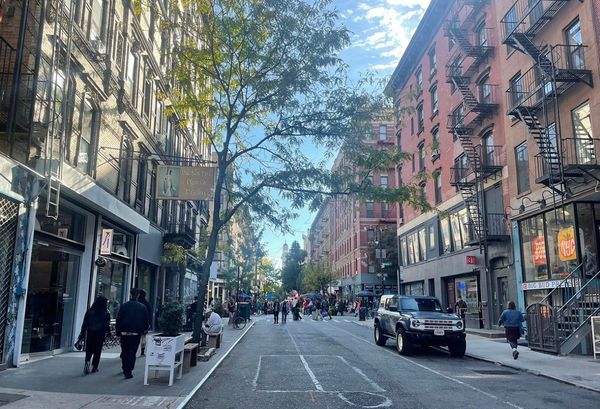
New York Has the Apartments. Albany Has the Key.
Since Albany passed its 2019 rent law, I have asked a simple question: Why can’t state policy protect tenants while still making it financially possible to restore aging apartments? Seven years later, the consequences are difficult to ignore.
On June 25, 2026, the New York City Rent Guidelines Board approved the first simultaneous freeze covering both one- and two-year rent-stabilized lease renewals in its history: 0 percent for each. Tenant advocates celebrated, and I understand why.
But I could not join them.
After more than two decades of owning, managing, and renovating multifamily housing in New York City, I have seen how housing policy reaches far beyond landlords and tenants. A rent freeze may offer short-term relief, but insurance, labor, fuel, and regulatory costs continue to climb. When revenue is frozen while expenses rise, the capital needed to repair, renovate, and preserve buildings erodes.
The freeze did not create the vacancy and rehabilitation problem described below. But it reflects the same policy mistake: treating rent, repair costs, and financing as if they can be separated. This is not an argument to abandon rent stabilization. It is an argument to preserve it by making necessary rehabilitation economically possible.
The process exposed sharp divisions. Arpit Gupta, a finance professor at New York University’s Stern School of Business, cast the lone dissenting vote, while owner representative Christina Smyth resigned hours before the final vote. “The Rent Guidelines Board has stopped being a fact-finding body,” she wrote. “It has become a body that starts with an answer and vibe codes its way backward to justify it.”
On July 22, a group of landlords with buildings in four boroughs filed suit in Staten Island Supreme Court, alleging a “sham” process and improper mayoral influence. Whatever the court decides, litigation cannot repair a single apartment or resolve the underlying economics.
The Real Cost of an Inadequate Cap
The Housing Stability and Tenant Protection Act of 2019 sought to protect tenants from sudden rent increases and displacement—an important goal. But it also created a new problem. By sharply limiting what owners can recover for improving vacant apartments, the law made many aging, deteriorated units financially impractical to restore.
Albany took a partial step in 2024 by expanding the Individual Apartment Improvement (IAI) program, administered by New York State Homes and Community Renewal (HCR), the state housing agency. The program allows an owner who improves a vacant rent-stabilized apartment to add a portion of documented costs to the apartment’s lawful regulated rent. The standard Tier 1 cap rose to $30,000, with the monthly increase calculated over 14 or 15 years depending on building size. A special Tier 2 cap of $50,000 is calculated over 12 or 13 years, but applies only to apartments registered vacant in 2022, 2023, and 2024, or vacated after at least 25 years of continuous occupancy. The 2024 amendment also made the resulting increases permanent, reversing the temporary treatment imposed in 2019. Those were genuine improvements, and Albany deserves credit for them.
Yet even the higher caps fall far short of real rehabilitation costs. They may cover routine turnover. They do not cover apartments with sagging floors, lead paint, asbestos, or failing plumbing and wiring. Architectural drawings, city filings, inspections, and hazardous-material cleanup can consume a large share of a $30,000 cap before construction begins.
So the math decides the outcome: an apartment needing only paint and a new stove gets re-rented. An apartment needing a gut renovation may sit vacant.
A true rehabilitation can require fire-resistant insulation, new subflooring, complete electrical and plumbing replacement, and repairs to the mortar between interior bricks. The worst damage hides behind walls and beneath floors, where decades of minor plumbing leaks quietly rot structural joists. None of that appears in a listing photo, and none of it gets fixed by cosmetic updates. Yet these repairs determine whether a century-old apartment remains safe for the next generation.
Reporters, economists, and housing analysts have done important work documenting New York’s housing crisis. But much of the debate still takes place at a distance from the physical buildings themselves, among people who have never priced a boiler replacement, waited for a Department of Buildings filing, or opened a floor to discover rotted structural joists. Data can illuminate the system, but they cannot fully capture the decisions confronting an owner who is legally and financially responsible for keeping a century-old building safe.
Beneath the Floor: A $29,100 Cautionary Tale
I have opened enough walls and floors in century-old buildings to know that the most expensive problems are often the ones no one can see.
In 2024, I spent roughly $160,000 to gut-renovate a 650-square-foot loft on the Lower East Side—about $250 per square foot. For perspective, 650 square feet is roughly the size of a typical two-bedroom apartment on the Lower East Side. This was a free-market apartment, not a rent-stabilized unit. I use the example because the same types of hidden structural damage can exist in regulated housing, and the cost of skilled labor, materials, permits, and professional services does not change with an apartment’s legal status.
When I removed the bathroom floor, I found rotted joists underneath—not a soft spot and not a repair I could schedule for later. Decades of small plumbing leaks had eaten the wood holding the floor up, and the structure was no longer safe.
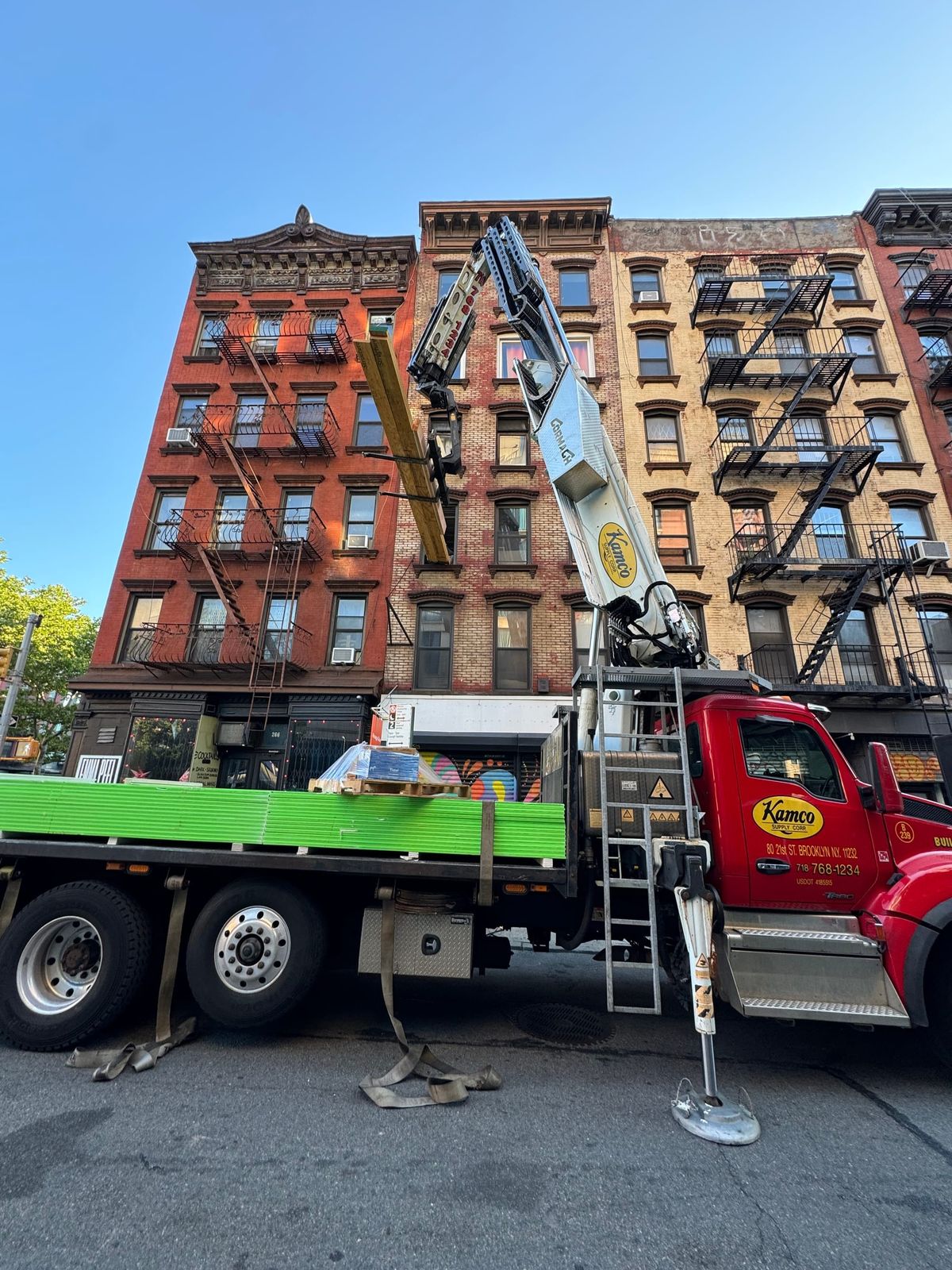
Those joists carried the kitchen and bathroom, so I brought in a structural engineer to determine how to reinforce and replace them correctly. The replacement beams—eighteen feet of engineered lumber—came through a third-floor window by boom truck, which required its own street permit. Rebuilding the floor required opening part of the ceiling in the occupied apartment below, so I moved that tenant to a hotel for six days and paid for meals and transportation.
The Hidden Physical Reality
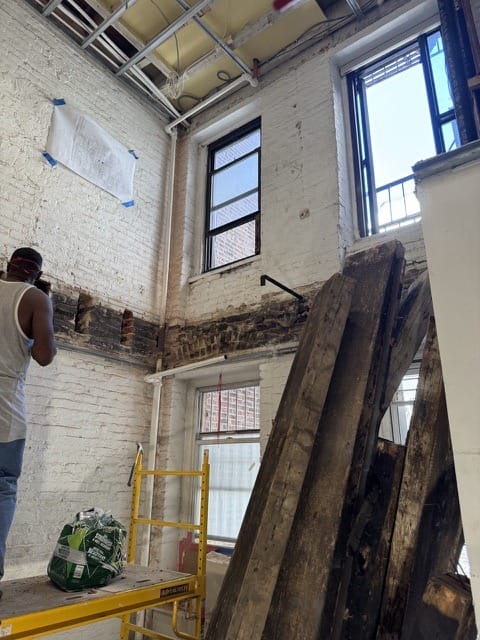
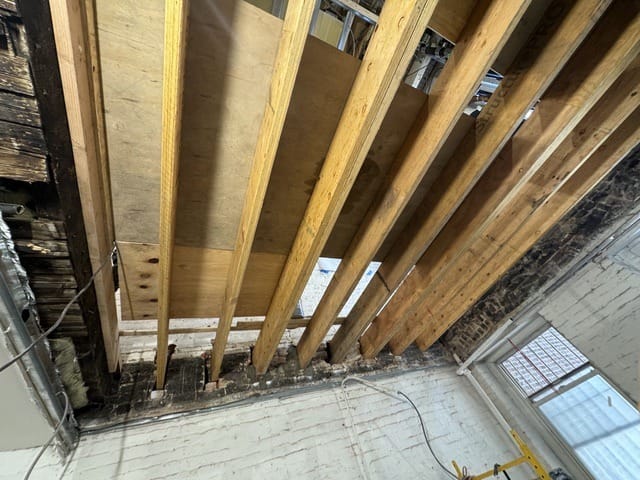
The bill for the structural repair and related expenses alone—before the rest of the apartment was demolished and before a single new wire, pipe, or fixture went in—was $29,100.
Item | Cost |
Hotel, meals, and transportation for the displaced tenants (6 days) | $5,000 |
Structural work—engineer, joists, ceiling below, and demolition of damaged area (labor and materials, about 30% of unit) | $14,000 |
Architect | $5,000 |
Permit expeditor | $3,450 |
City fees | $1,650 |
Total structural repair and related costs | $29,100 |
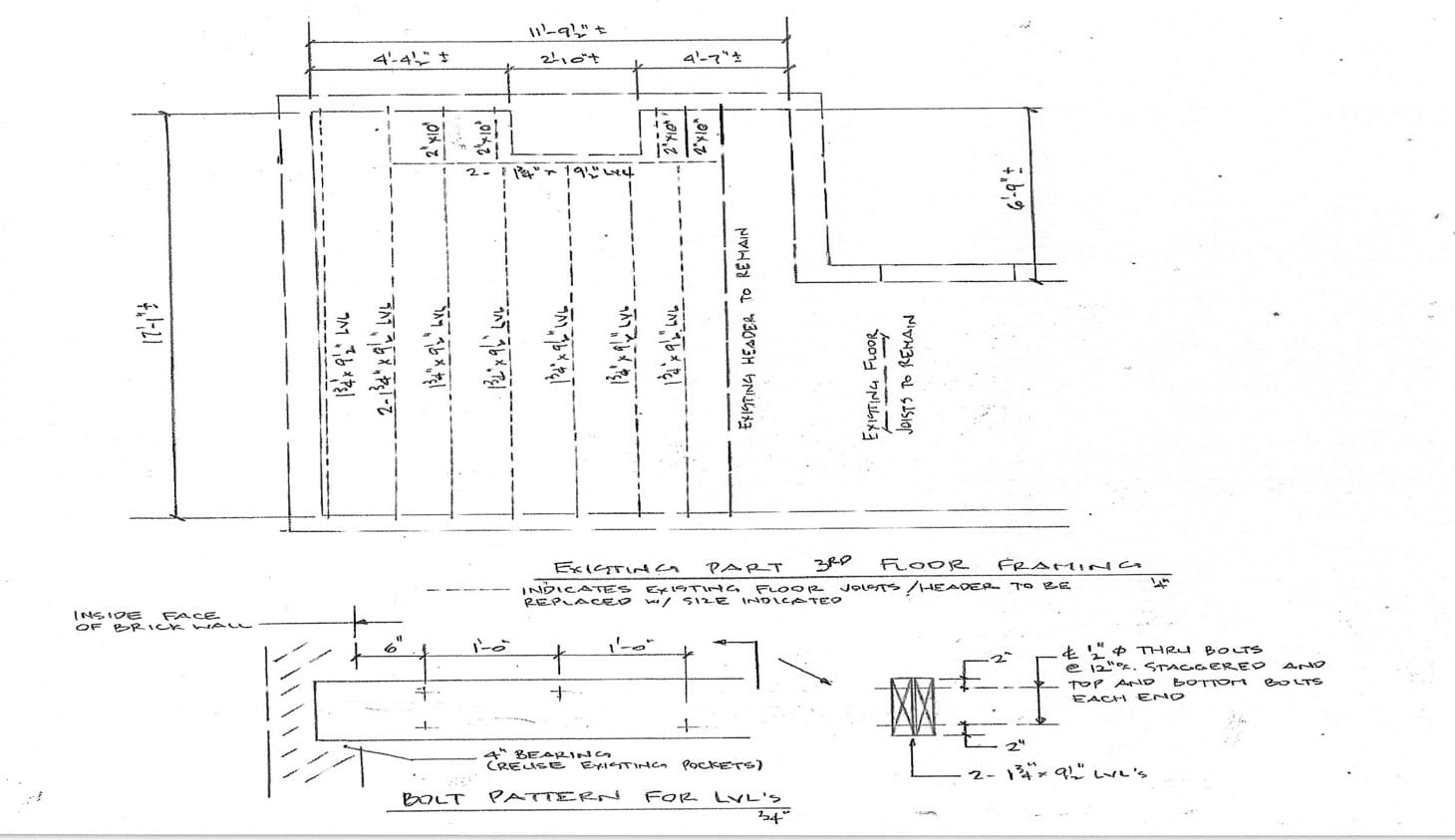
Under the state housing agency’s rules, ordinary repairs do not automatically count toward the improvement cap. A repair qualifies only when it is performed as a necessary part of an eligible apartment improvement. Not every line item above would necessarily qualify. The excluded costs do not disappear; the owner must absorb them outside the program.
Assume, for illustration, that the full $29,100 qualified as necessary components of an apartment-wide modernization. It would consume 97 percent of the standard $30,000 Tier 1 cap and about 58 percent of the limited $50,000 Tier 2 cap—before new plumbing, wiring, flooring, walls, fixtures, or appliances.
The Math Disconnect
$29,100 spent on structural safety, engineering, tenant relocation, permits, and related costs.
If all of it qualified under Tier 1, only $900 of the cap would remain. That $900 would have to cover rewiring, plumbing replacement, floor leveling, walls, ceilings and closets, windows, heating and cooling systems, brick-and-mortar repair, cabinets, countertops, tile, fixtures, flooring, and appliances.
Nobody walking through that apartment before demolition would have seen the damage coming. It does not appear in a listing photo. If the apartment had been rent-stabilized, the standard cap would have covered only a fraction of a complete rehabilitation.
This is the fundamental disconnect at the heart of New York’s housing debate.
The contradiction is stark. The 2023 Housing and Vacancy Survey found a citywide net rental vacancy rate of just 1.41 percent—an acute shortage. Separately, state registration data show that the number of rent-stabilized apartments registered as vacant rose from 49,426 in April 2024 to 57,421 in April 2025. Those registrations are not a measure of long-term warehousing or rehabilitation need: they do not reveal why each unit was vacant or how long it remained empty, and they include normal turnover. But the increase deserves attention. During a housing crisis, policy should make it easier—not harder—to repair genuinely unavailable apartments and return them to the market.
New construction is essential, but it takes years. A gut renovation of an existing apartment can often be completed in months. That speed matters for vulnerable renters: a housing voucher cannot help a family if no suitable apartment is available.
Scarcity also creates other risks for renters. I have seen one firsthand. This year, scammers copied my name, photograph, and New York real estate broker credentials to post apartment listings on social media for units they did not control and solicit “holding” fees from prospective renters. The city’s housing shortage did not create the fraud. It created the urgency the scammers exploited: renters feared that pausing to verify a listing would mean losing the apartment. A market this tight does more than drive up prices. It makes people more vulnerable to those who weaponize desperation.
The Economic Ripple Effect
The damage spreads outward. Renovation is one of the city’s blue-collar employment engines. Unlike new construction, the work is dispersed across every neighborhood and flows directly to small contractors and supply houses, many of them immigrant-owned. A frozen renovation pipeline is a frozen job pipeline. A neighborhood paint supplier told me his sales have dropped nearly 30 percent as apartment turnover has stalled. Federal data reinforce the cost pressure: private-sector compensation in the New York–Newark region rose 3.3 percent over the year ending June 2026, including a 3.1 percent increase in wages. Labor is one of the largest components of apartment renovation, so higher wages and benefits ultimately flow into contractors’ bids—even as the volume of available renovation work contracts.
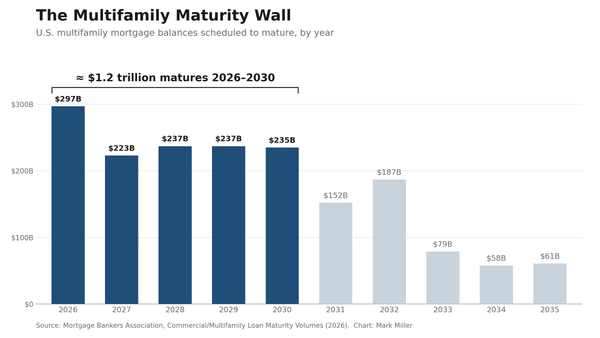
A broader financing crisis is already bearing down on the city’s housing stock. According to analysis by Maverick Real Estate Partners presented to the Rent Guidelines Board in May 2025, roughly $131 billion of mortgage debt is tied to rent-stabilized buildings citywide. About 45 percent—approximately $59 billion—sits on properties where at least 75 percent of the units remain regulated. Much of that debt was issued at low interest rates and is coming due in a more expensive lending environment.
The mechanics matter. Owners commonly fund major repairs with short-term construction or bridge loans and then refinance them into commercial mortgages. Many of those mortgages carry five-year terms. Maverick also reported that new mortgage lending on highly regulated buildings has fallen by more than 70 percent from pre-2020 levels. It found sale prices per square foot at or below outstanding debt per square foot in multiple boroughs, indicating that nearly half of these owners may have negative equity—their buildings may be worth less than the debt against them.
If rental income is frozen while operating costs and interest rates rise, lenders may conclude that a building cannot support a new loan. Albany’s current 12-to-15-year cost-recovery schedules can span two or three commercial-mortgage cycles. A seven-year schedule would bring cost recovery closer to real lending and investment horizons while still spreading it over time.
When refinancing fails, a loan can slip into default even when the owner is trying to preserve the property. Maintenance gets deferred, property values fall, and tenants live with the consequences: the boiler that is not replaced and the roof that is not repaired.
That risk is no longer theoretical. Bloomberg recently reported that the mortgage underlying a $506 million commercial mortgage-backed securities transaction—secured by 53 A&E Real Estate buildings containing largely rent-stabilized apartments—went into default after it matured in 2024 and A&E was unable to refinance amid higher borrowing and operating costs. Analysts estimated the properties’ value at approximately $460 million, down from an appraisal of roughly $717 million when the bonds were issued, implying potential losses of more than $80 million for bondholders.
That is the debt side of the warning. The same pressures are appearing on the equity side. Bloomberg separately reported that A&E said its operating expenses had increased by more than 78 percent over the past decade, far outpacing rent growth. An entity affiliated with Google co-founder Sergey Brin sold its interest in an A&E fund holding nearly 5,900 New York City apartments back to the manager. A&E said the investor accepted roughly six cents on the dollar of its original equity. The University of California separately wrote down its $115 million investment in the same fund by about half.
The mortgage default and investor losses preceded the 2026 rent freeze, so the freeze did not cause them. They reveal the deteriorating financial conditions upon which the freeze was imposed. Whatever judgment one makes about A&E’s management, losses suffered by bondholders and outside equity investors remain market signals about how capital providers are assessing the risks of regulated housing.
Because UC Investments manages retirement, endowment, working-capital, and cash assets, its write-down is more than an investor’s private misfortune. It is another warning that the capital needed to refinance, repair, and preserve New York’s housing stock is losing confidence in the underlying economics.
Those signals matter beyond private balance sheets. Financial distress eventually reaches the city’s own finances. Property taxes are New York City’s steady paycheck. Preliminary fiscal-year 2026 collections reached approximately $35.4 billion—up 2.2 percent from $34.7 billion in fiscal year 2025. Property taxes provided more than 40 percent of city tax receipts and remained the city’s largest single tax source. That revenue helps fund teachers, firefighters, police officers, sanitation workers, social services, and housing programs. Renovations also generate permit fees, while property sales and refinancings can produce real-property transfer and mortgage-recording taxes.
Business Improvement Districts depend on the same property base. Their special assessments are billed and collected from local property owners through the city’s property-tax system. Having led the Lower East Side BID, I have seen firsthand how directly supplemental street-cleaning and public-safety services depend on buildings remaining financially viable and able to pay their share.
These financial warnings also sit uneasily beside the Rent Guidelines Board’s own cost analysis. Its 2026 Price Index of Operating Costs found that real-estate taxes on buildings containing stabilized apartments rose 2.6 percent, while total operating costs had risen 5.3 percent and were projected to rise another 4.1 percent. All three of the staff’s illustrative formulas produced positive rent adjustments. The Board expressly cautions that those formulas are not recommendations and must be considered alongside tenant affordability and the rest of its statutory mandate.
Tenant hardship is real. So is cost arithmetic: a zero adjustment does not eliminate rising taxes and operating expenses; it assigns them entirely to property owners. The city cannot depend on property owners for a growing and reliable stream of tax revenue while assuming that the regulated income used to pay those taxes can remain frozen without consequences.
When investors cannot see a credible path to recover their capital, that capital leaves.
The Solution: Indexing Caps to Physical Reality
Albany can address both problems—the inadequate caps and the mismatched financing timeline—without a single dollar of taxpayer subsidy. It should replace arbitrary flat caps with a clear, objective recovery rule tied to real construction and financing conditions.
Owners should be allowed to recover documented and independently verifiable rehabilitation and improvement costs of up to $250 per square foot for vacant apartments, with the monthly adjustment calculated over seven years rather than 12 to 15. The per-square-foot ceiling would limit the amount used to calculate the rent adjustment and should be reviewed periodically against New York-area construction-cost data. The $250-per-square-foot figure would be a ceiling on documented recoverable costs, not a required renovation budget. Owners could choose to spend more, but no adjustment would be calculated on costs above the statutory ceiling; many owners would spend less. But an owner who wants to add a dishwasher or washing machine to a hundred-year-old apartment should not find that the rules make the investment irrational. Plenty of free-market apartments offer neither amenity. Regulation should protect tenants; it should not be the reason a stabilized apartment becomes a worse apartment.
Within that objective limit, owners should remain free to decide the scope, design, materials, and quality of their renovations. HCR’s role should be to verify that the work was performed, the expenses were documented and paid, required permits were obtained, and the work complied with applicable law—not to manage an owner’s investment decisions.
Unlike today’s flat-dollar caps, this approach would recognize that renovation costs generally vary with apartment size: a smaller apartment would have a lower recovery ceiling, while a larger apartment would have a higher one. Under this structure, for example, a 650-square-foot apartment would qualify for no more than $162,500 in recoverable costs, producing a maximum monthly adjustment of about $1,935—but only when the work and expenses are documented and independently verified. As with current apartment-improvement increases, the adjustment would remain part of the apartment’s lawful regulated rent.
The state should build on the safeguards it already created: pre-work registration; before-and-after photographs; required permits; itemized invoices; proof of payment; licensed contractors; and filings after the work is completed. The state agency should add random and risk-based audits, meaningful penalties for fraud, and a clear process for tenants to review the supporting records. The answer to past abuse is objective verification, not government management of renovation choices.
Critics will say that a higher recovery cap means higher rents. That concern deserves a serious answer. Under this proposal, no current tenant would be subject to the adjustment. It would apply only after an apartment became vacant, and the incoming tenant would see the lawful rent before deciding whether to sign the lease. There would be no surprise increase imposed on a tenant in place. The protection against abuse should be a firm per-square-foot recovery ceiling, transparent records, strict verification, audits, and meaningful penalties. A rent adjustment would become available only after an owner invested real capital in the apartment, and costs above the ceiling would remain entirely the owner’s responsibility. But an empty apartment is affordable to no one.
The 2019 law addressed real abuses. Seven years of experience now give Albany a basis to refine it. Lawmakers should revisit these apartment-improvement provisions with tenants, owners, lenders, and labor at the table—not to unwind tenant protections, but to house families waiting for apartments, keep aging buildings standing, and protect the tax base that pays for the services every New Yorker depends on.
Effective housing policy must do two things at once: protect tenants and encourage investment. Those goals need not be in conflict. Real affordability does not come from freezing rents if the result is a frozen housing supply. It comes from making it viable to repair existing homes, maintain buildings, and return empty apartments to the market.
New York has the apartments. Albany has the key. Turn it, and the hammers start swinging again.
About the Author
Mark Miller owns, manages, and renovates multifamily housing in New York City. He is a licensed New York real estate broker, home improvement contractor, seventh-generation New Yorker, and fourth-generation Lower East Side property owner. He serves on the board of the Lower East Side Partnership and previously served as president of its predecessor organization, the Lower East Side Business Improvement District from 2008 to 2012. The views expressed are solely his own.