When the Mortgage Comes Due: The Next Test for New York's Apartment Buildings
A companion to "New York Has the Apartments. Albany Has the Key."
A building can be fully occupied, collecting every dollar of rent, and still be headed for a financial crisis.
The reason is simple: mortgages end.
Most apartment building loans don't run for 30 years like a home mortgage. They come due after five, seven years. In my experience, ten-year money is hard to come by for multifamily, and today many lenders won't go past five. When a loan comes due, the owner must pay off the balance, usually by taking out a new loan, or negotiate more time. Nothing resets automatically.
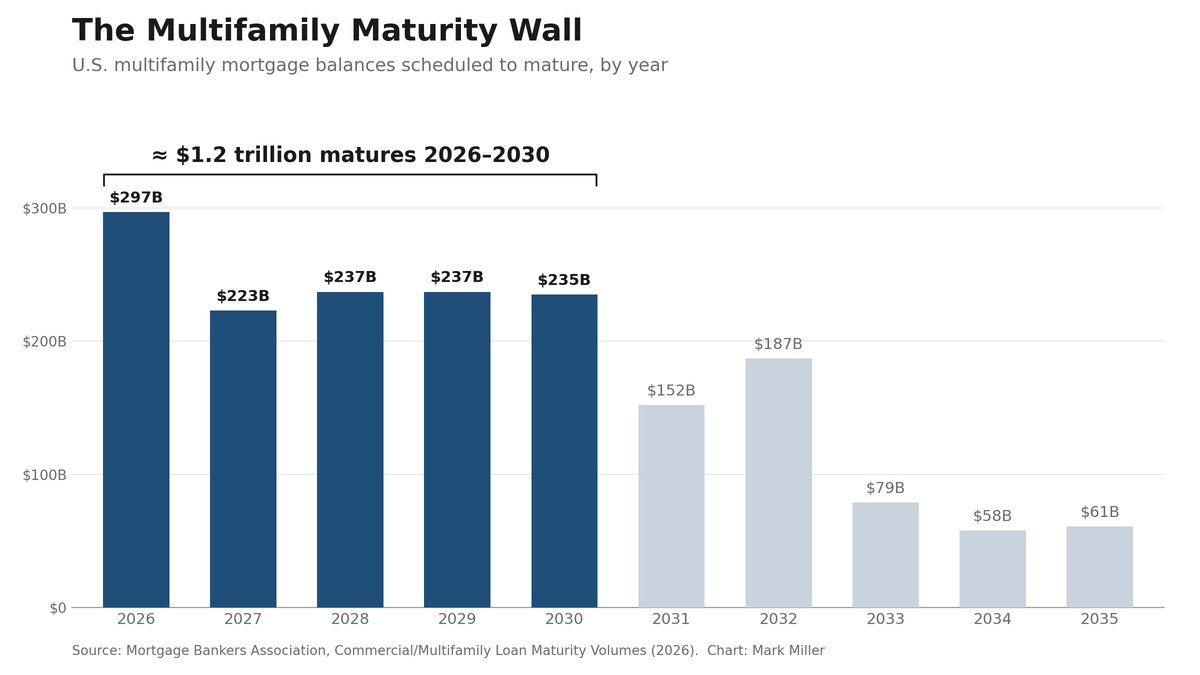
That is why the chart below matters. According to the Mortgage Bankers Association, $297 billion in apartment building loans nationwide come due this year, followed by $223 billion, $237 billion, $237 billion, and $235 billion in each of the next four years. From 2026 to 2030, that adds up to roughly $1.23 trillion. Not every one of those loans will go bad, but it is an enormous test, and it arrives at a time when interest rates are far higher than when most of these loans were made.
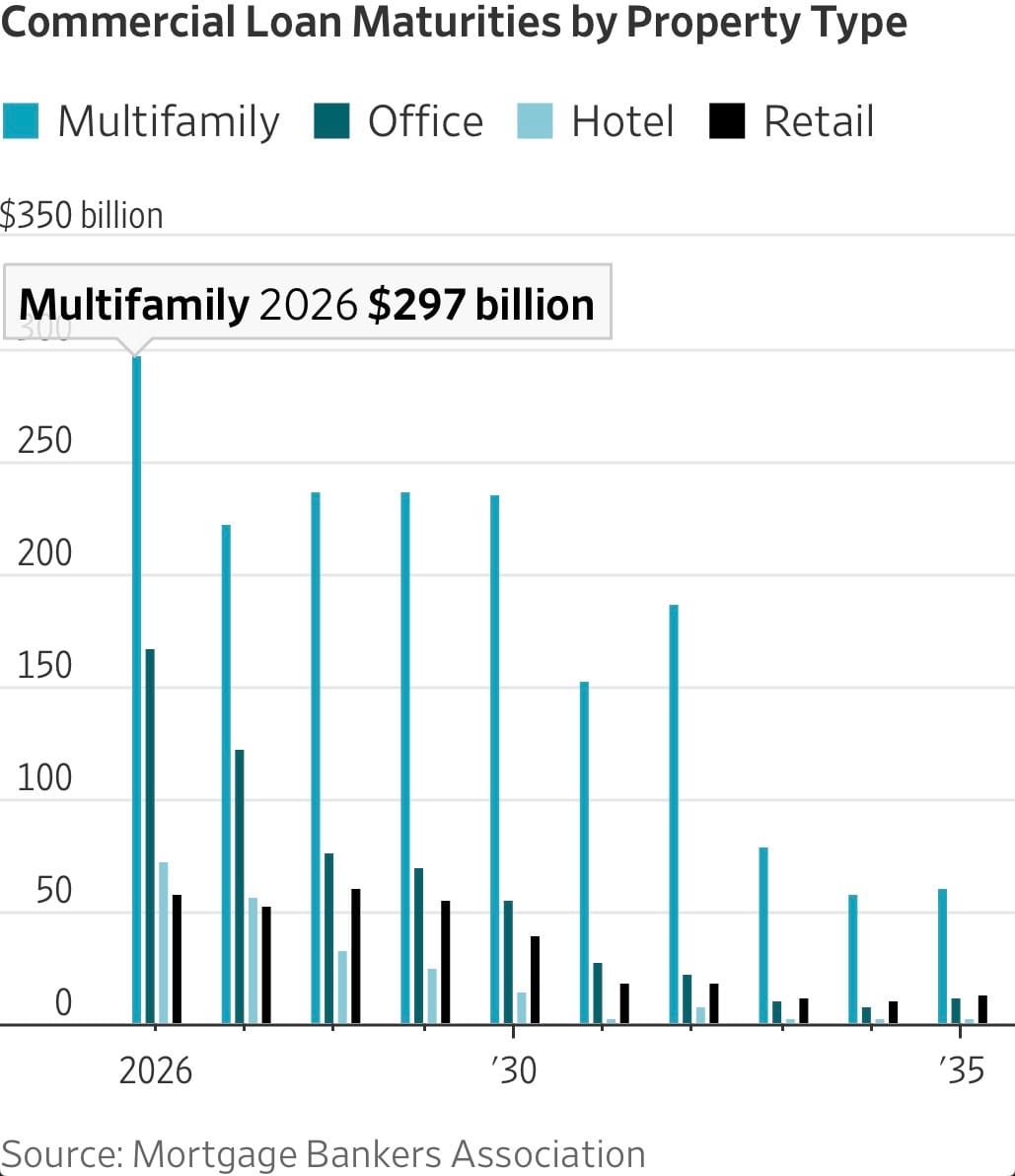
Chart. Source: Mortgage Bankers Association, as published by Rebecca Picciotto in The Wall Street Journal.
New York's exposure is its own story. As I noted in the earlier piece, Maverick Real Estate Partners told the Rent Guidelines Board in May 2025 that roughly $131 billion in mortgage debt is tied to rent-stabilized buildings citywide, and that about 45 percent of it — roughly $59 billion — sits on properties where at least 75 percent of the units remain regulated. Much of that debt was written at low rates and is coming due in a more expensive lending environment. These buildings cannot raise rents to meet the new payment, because the Rent Guidelines Board sets what they can charge.
The bill comes due, and the owner has to write a check
Many of these loans were written when interest rates were near 3%. Refinancing today can mean paying more than twice that. And relief isn't coming soon. On September 16, the Federal Reserve raised its benchmark rate for the first time since July 2023, and its own projections point to another increase before the end of the year. Here is a simple example of what that means for a building:
$5 million interest-only loan | At 3% | At 6.5% |
Building income after operating expenses | $400,000 | $400,000 |
Annual interest | $150,000 | $325,000 |
Cash left over | $250,000 | $75,000 |
Same building, same tenants, same rents. The money left for repairs, savings, and emergencies falls by 70%.
The bigger problem is the size of the new loan. Banks don't simply renew the old balance. They lend based on what the building earns today. If a new lender requires the loan to be paid down over a 30-year amortization schedule — meaning the payment is calculated as if the loan ran 30 years, even though it comes due in five or seven — and wants the building's income to exceed the mortgage payment by 25%, this building qualifies for only about $4.2 million, not the $5 million it owes. The owner must come up with roughly $800,000 in cash just to keep the building.
Owners who have that money will pay it. Owners who don't will have to sell, bring in partners, or hand the keys to the bank. (These figures are illustrative, not actual loan quotes.)
Where the rent freeze comes in
In New York City, this wall of maturing loans is colliding with a second pressure. On June 25, 2026, the Rent Guidelines Board voted 7-1 to set increases at zero for both one-year and two-year leases on the city's roughly one million rent-stabilized apartments. The city has frozen one-year leases before. It has never frozen a two-year lease until now. The freeze covers leases beginning between October 1, 2026, and September 30, 2027. A tenant who signs a two-year lease next summer won't see an increase until 2029.
The freeze gives tenants real relief. It does not freeze the cost of keeping their homes standing. Insurance, heating fuel, water, labor, and repairs keep rising. Go back to the example: if expenses climb just $25,000 while rents stay flat, the $75,000 cushion shrinks to $50,000. And because banks lend based on income, every dollar of lost income makes the gap at refinancing wider and the check the owner has to write larger.
Who pays when a building can't
The consequences don't stay with the owner. When a building can't cover its operating costs, its mortgage, and its repairs, the first thing to go is usually maintenance. Repairs get put off. Conditions decline. Owners look for emergency financing or try to sell. In the worst cases, the financial trouble becomes a housing problem, and the tenants live with the results.
When a quick sale is the only way out
For an owner who can't refinance, selling quickly is often the best outcome for everyone. The bank gets repaid. A buyer with the money to fix the building steps in. The tenants get an owner who can afford to take care of their homes.
The City Council is considering a law that would make that harder.
The Community Opportunity to Purchase Act, known as COPA, would give nonprofit groups approved by the city the first chance to buy certain apartment buildings before anyone else can. The Council's housing committee held a hearing on the bill on September 9, and it has not yet come to a vote. Here's how it would work as written.
Before taking any step to sell, the owner must notify the city and every approved nonprofit. Any nonprofit that expresses interest gets the building's rent roll, expenses, and mortgage balance. It then has 20 days to say it's interested and 70 more days to make an offer, and it can ask for an extension. During that time, the owner cannot sell to anyone else. If the owner turns down the nonprofit's offer, the nonprofit can still match any other buyer's offer for a full year. An owner who sells without following these rules faces a fine of up to 15 percent of the sale price, and nonprofits can sue.
The law doesn't cover every building. It targets buildings the city considers "distressed." These include buildings averaging three or more serious open violations per apartment over a year, buildings in the city's program for the worst-maintained properties, buildings facing foreclosure over unpaid city taxes, and smaller buildings whose affordability protections are about to expire. The city can add more categories on its own.
Now look at what the bill leaves out.
It exempts foreclosures sold through the courts, and it exempts an owner simply handing the deed to the bank. But a sale to a new owner, even one where the bank agrees to accept less than it's owed, has to go through the full process. In other words, the law puts its waiting period on the rescue and waves the failure straight through.
That is backwards. Foreclosures are slow and expensive. Repairs stall while lawyers argue, and tenants are caught in the middle. A sale to a buyer with money to spend is the fastest route to a repaired building, and it is the one route the bill slows down.
Then the sequence plays out.
A rent freeze and a refinancing gap drain a building's cash. Repairs get put off. Violations pile up. The building becomes "distressed" under the law just as the owner is running out of time. Instead of selling to the buyer who can close fastest, the owner must wait up to three months or more, and even then, a nonprofit can step in and match any deal for the next year.
A bank facing an unpaid loan is under no obligation to wait for any of this. Buyers who could close quickly may not bother spending money on inspections and lawyers for a deal someone else can take away. Fewer buyers means lower offers, and a lower offer may not cover the loan.
Supporters point out that owners can apply for a hardship waiver. But the bill says only that the city may grant one. The standards haven't been written, and there is no deadline for a decision. A buyer can't rely on a waiver that hasn't been granted, and a bank won't wait for one. The owners who need it most are the ones with the least time.
Supporters also want to keep troubled buildings affordable and out of the hands of speculators. That is a fair goal. But the city has already tried the direct approach, and the results should give the Council pause.
HPD's Neighborhood Pillars program offers nonprofits and mission-driven buyers low-interest loans, tax exemptions, and a subsidy of up to $380,000 per apartment to acquire and repair distressed rent-stabilized buildings. The city relaunched it in April 2025. More than a year later, HPD's own commissioner told the Council that the program had yet to close a single project, calling it "a little bit slow-going." The original version, launched in 2018, aimed at nearly 7,500 homes and financed a few hundred.
That record is the strongest argument against COPA. If nonprofits cannot close on these buildings with $380,000 per unit already on the table, a 90-day exclusive window will not change the outcome. The city gets the delay without getting the nonprofit owner.
Supporters will say the bill is really about information — that nonprofits often don't learn a building is for sale until the deal is done. That is a fair concern, and it has a simpler fix. Require the owner to notify the city's qualified-buyer list when a covered building goes on the market. That gives nonprofits the information without giving them a veto, and it costs no one ninety days.
The answer is to fix the tool the city already has, not to build a waiting period around it. Find out why Pillars deals stall — pre-qualification, layered approvals, appraisal timelines, board sign-offs — and give qualified nonprofits standing credit lines and as-of-right terms so they can make a clean offer in days rather than months. A nonprofit that can compete on price and speed does not need a law to hold the door.
At the very least, the Council should exempt sales of buildings whose mortgages have matured or are in default, require a fast answer on hardship requests, and shorten the year-long matching right. A law meant to protect tenants in struggling buildings should not delay the very rescue those buildings need.
Why this matters to every New Yorker, not just landlords
Think of New York City as a circle. Residents, workers, businesses, property owners, and government all depend on one another. When one part weakens, the whole circle feels it.
Property taxes are the largest single source of the city's revenue. In this year's city budget, property taxes are expected to bring in $37.3 billion, or 42.1 percent of all city tax revenue. That money pays for schools, police, firefighters, sanitation, and the pensions of the people who have served this city.
Apartment buildings are a major part of that tax base, and the city values rental buildings largely on the income they produce. When rents are frozen while costs climb, building income falls, and over time, so does the value the city can tax. When owners fall into trouble, some fall behind on their taxes and water bills. When buildings end up in foreclosure or sell at distressed prices, the city's revenue suffers along with the housing.
That is the ecosystem at stake. Decisions made at City Hall and in Albany either strengthen that circle or wear it down.
The cost of making New York harder to afford
New York already asks a great deal of the people and businesses who live and invest here. Yet the instinct in government is too often to find one more thing to tax. This year alone, Mayor Mamdani floated a 9.5 percent property tax increase, worth roughly $3.70 billion, before dropping it. Albany enacted a new pied-à-terre surcharge on New York City residences that are not a primary home, reaching one- to three-family houses valued at $5 million or more, and, in its first phase, condos and co-ops assessed at $1 million or more. Drivers already pay a congestion toll to enter Manhattan, and under the MTA's published phase-in schedule the peak toll for cars rises from $9 to $12 in 2028 and to $15 by 2031.
Each measure may sound targeted on its own. Together, they send a message: New York is expensive, and it keeps getting more so. People, businesses, and investors have choices, and other states are actively competing for them. If New York wants to keep growing, it has to compete, and that starts with a government that lives within its means.
An easy win: let owners fix empty apartments
There is a way to create jobs, add housing, and grow the tax base without asking overtaxed New Yorkers for another dollar.
As I argued in "New York Has the Apartments. Albany Has the Key.", thousands of rent-stabilized apartments sit empty because renovating them no longer makes financial sense under current law. Albany could change that by letting owners recover a meaningful investment, up to $250 per square foot, through a rent increase on the renovated apartment, with audits to keep the process honest.
The speed is the point. In my experience, a gut renovation takes three to five months. A new building takes two years or more. Renovation puts contractors, tradespeople, and suppliers to work right away, returns apartments to the market quickly, and strengthens the buildings that pay the city's bills.
Protecting tenants and the buildings they live in
None of this means tenants should pay for an owner's borrowing decisions. Owners, lenders, and policymakers all share responsibility, and a rent-stabilized building is people's homes, not just an investment whose costs get passed down to residents.
But housing policy has to reckon with what it actually costs to keep a building safe, maintained, and financially sound. A rent freeze can offer real short-term protection, especially for households already stretched thin. A law that slows the sale of troubled buildings while letting foreclosures through may be well-intentioned. But when these policies ignore rising costs, maturing loans, and the need for quick rescues, they can weaken the very housing they are meant to protect, along with the tax base that supports every New Yorker.
We are all part of the same circle. The goal should be to protect tenants, keep their buildings standing, and keep New York a place worth investing in, not one at the expense of the others.
About the Author
Mark Miller owns, manages, and renovates multifamily housing in New York City, and is a licensed New York real estate broker and home improvement contractor. He is a seventh-generation New Yorker and a fourth-generation Lower East Side property owner. He serves on the board of the Lower East Side Partnership and was president of its predecessor, the Lower East Side Business Improvement District, from 2008 to 2012.
He owns and finances both free-market and rent-stabilized buildings. The views expressed are his own.